A Deep Dive into Taiwanese Tea
On a map, Taiwan is a small, rugged island off the coast of China. In the world of tea, it looms surprisingly large. For many tea drinkers, Taiwanese tea means one thing above all: oolong of rare finesse, grown high in the mountains and crafted with extraordinary care. Look a little closer, and you discover a far richer story – one of black teas with honeyed perfume, evolving traditions, and a culture that treats tea less as a commodity and more as an art form.
Taiwanese tea is respected globally because it is relentlessly origin‑led. Gardens cling to steep slopes at altitude, clouds drift in and out throughout the day, and producers focus on small‑batch, artisanal methods that foreground terroir. The island is best known for its high‑mountain oolongs, but also produces distinct black, green and speciality teas that share the same devotion to craft.
This guide will explore what Taiwanese tea is, how it developed, the key types you’ll encounter and how to prepare them using traditional methods. The aim is simple: to help you move from curiosity to informed appreciation, so that the next time you see “Taiwan” on a label, you know exactly why it deserves your attention.
What is Taiwanese Tea?
At its simplest, Taiwanese tea is tea grown and produced in Taiwan. That includes green, oolong and black teas, but globally the island’s reputation rests above all on its oolong – especially the high‑mountain, or gaoshan, teas grown at impressive altitudes.
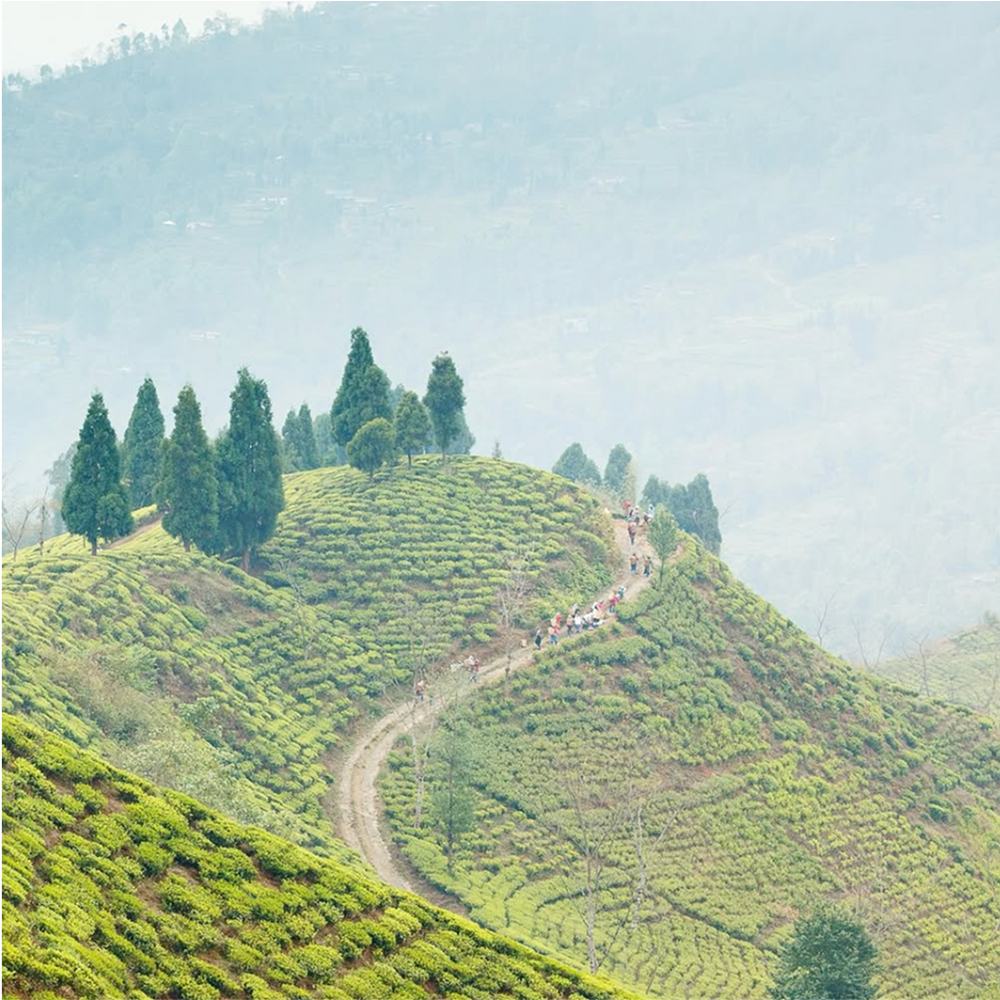
Altitude is one of Taiwan’s great advantages. Many of its most celebrated tea gardens sit between 1,000 and 2,600 metres above sea level. Up there, cooler temperatures slow the growth of the leaves, mists roll in regularly, and the plants experience large temperature differences between day and night. Those stresses encourage the development of more aromatic compounds and a softer, more refined texture in the leaf.
Soil and climate vary dramatically between regions, but what unites much of Taiwanese tea is the emphasis on terroir: the idea that where the tea is grown – the slope, the exposure, the surrounding vegetation – shows up clearly in the cup.
Equally important is the way tea is made. Taiwanese tea production is dominated by artisanal, small‑batch methods. Leaves are often hand‑picked, withered in thin layers, and carefully monitored as they oxidise and are rolled, sometimes over the course of many hours or even days. Many producers still work in family‑run factories, handing down knowledge from one generation to the next.
All of this places Taiwanese tea naturally in the premium and luxury segment. You are not paying for marketing flourish; you are paying for altitude, craft, and the patience it takes to create a tea that can evolve over many infusions without losing its poise.
A Brief History of Tea in Taiwan
Tea did not originate in Taiwan; it arrived with people. In the 17th to 19th centuries, migrants from China’s Fujian province brought tea plants and their knowledge of cultivation and oolong making to the island. They found familiar conditions in parts of Taiwan’s mountainous terrain and set about adapting their techniques to new landscapes.
By the late 19th century, Taiwan had become a significant tea exporter, with pouchong (a lightly oxidised tea similar to today’s Baozhong) and oolong heading to markets in Europe and North America. Tea flourished alongside other agricultural products, helped by the island’s natural suitability and growing international demand.
Japanese rule from 1895 to 1945 left its mark too. The colonial administration invested in agricultural research stations and infrastructure, improving some aspects of cultivation and introducing new cultivars and production methods. After the Second World War, as Taiwan’s economy developed, the tea industry gradually shifted focus from volume exports towards quality and domestic consumption.
From the latter half of the 20th century onwards, Taiwan’s tea story has been one of refinement and specialisation. Producers honed their oolong craft, experimented with new styles and embraced high‑mountain cultivation, which has since become almost synonymous with Taiwanese tea in the minds of enthusiasts.
Today, the island is recognised for its precision, consistency and willingness to innovate within tradition – whether that’s adjusting oxidation levels to suit contemporary palates, reviving heritage cultivars, or fine‑tuning roasting regimes to reveal different layers of flavour.
Types of Taiwanese Tea
While oolong is the headline act, Taiwanese tea is more diverse than its reputation might suggest. Broadly, teas from Taiwan can be grouped into the same categories as elsewhere – green, oolong and black – with oolong and black being the most distinctive.
The classification rests heavily on oxidation – the controlled browning reaction that transforms fresh green leaves into something darker and more aromatic. Green teas are unoxidised, oolongs sit somewhere in the middle, and black teas are fully oxidised. In Taiwan, producers have turned the middle ground into a creative playground, exploring everything from very lightly oxidised, almost green oolongs to deeply roasted styles that verge towards black tea in character.
What makes the Taiwanese expressions of these categories stand out is how directly they connect oxidation, terroir and flavour to the way you prepare and drink them.
Taiwanese Oolong Tea Explained
Oolong tea is sometimes called the “champagne” of tea categories, and nowhere is that more apparent than in Taiwan. By definition, oolong is partially oxidised, but that covers a world of possibility. In Taiwan, oxidation levels can range from around 10–15% (very light) to 60–70% (much darker), and the spectrum of flavour is just as broad.
At the lighter end you’ll find high‑mountain oolongs from places like Ali Shan, Li Shan and Shan Lin Xi. These teas are often rolled into tight, emerald‑green beads during processing. When they hit hot water, the leaves slowly unfurl, releasing aromas of orchid, gardenia and fresh butter. In the mouth, they can feel creamy yet weightless: smooth, silky and lingering, with a sweetness that builds over multiple infusions.
Slightly more oxidised styles, like some Tieguanyin‑inspired teas or classic Baozhong from Pinglin, bring more fruitiness and depth. Baozhong, which is loosely twisted rather than rolled, can be remarkably floral and verdant, with notes of lilac, tropical fruit and a gentle, cooling finish.
Darker, more heavily oxidised and roasted oolongs from regions such as Dong Ding introduce yet another dimension. Here you might find toasted nuts, caramel, baked stone fruit or a gentle charcoal edge, all balanced by the intrinsic sweetness of good leaf.
The processing behind these teas is intricate. After picking, leaves are withered in the sun and indoors, shaken or tumbled in bamboo drums to bruise their edges, then rested to oxidise. The tea master monitors aroma, colour and feel, deciding when to apply heat, how hard to roll, and how deeply to roast. Small differences in timing and handling can have dramatic effects on the final cup.
Altitude adds another layer. High‑mountain oolongs tend to have extraordinary clarity and a cool, almost alpine character, with a long, clean aftertaste that can stay on the palate for minutes. Lower altitude teas can be more robust and assertive. One of the joys of Taiwanese oolong is exploring how these factors combine, infusion after infusion.
Taiwanese Black Tea Explained
Although less famous than its oolong, Taiwan’s black tea is a quiet treasure. In regions such as Sun Moon Lake in central Taiwan, producers have developed black teas that are aromatic, elegant and distinct from their Indian or Chinese counterparts.
Like all black teas, Taiwanese black tea is fully oxidised. After withering and rolling, the leaves are left to oxidise until they reach a deep mahogany colour, before being dried to fix their character. What sets them apart is the combination of local cultivars, climate and artisanal handling.
Many Taiwanese black teas are made from cultivars such as Ruby 18 (Hong Yu) or Assam hybrids that thrive in the island’s subtropical conditions. Ruby 18, in particular, is prized for its complexity: a natural hint of wintergreen or clove, layered over dark honey, dried fruit and a rounded, almost syrupy body.
Compared to a typical Assam, Taiwanese black teas can feel lighter on the palate and less tannic, with a focus on aroma rather than brute strength. They are still satisfying and full‑bodied, but often more nuanced – closer, perhaps, to a fine Darjeeling second flush in their interplay of fruit, spice and structure.
For drinkers who think of Taiwan only in terms of oolong, discovering these black teas can be a revelation. They show what happens when an island known for meticulous oolong craft applies the same precision to a different oxidation endpoint.
What Makes Authentic Taiwanese Tea Different
Authentic Taiwanese tea is more than a label; it is the outcome of a particular set of growing conditions, production choices and values.
High altitude is a defining factor for many of the island’s most celebrated teas. Cooler temperatures slow leaf growth, giving plants time to develop more complex chemistry. Mist and cloud cover protect leaves from harsh sun, helping them retain juiciness and tender texture. The result is teas with concentrated flavour and a natural sweetness that feels integrated rather than imposed.
Production is typically small‑scale and artisan. Many gardens are family‑run, with limited acreage and a focus on quality over quantity. Hand‑picking remains common, especially for premium grades, and producers are closely involved in every step from fresh leaf to finished tea.
Processing expertise is another hallmark. Controlling oxidation – how far it goes, how evenly it develops, how it is layered with roasting – is part science, part intuition. The best tea makers have spent decades honing this sense, adjusting their techniques to the tiniest changes in weather and leaf.
In the market, these teas sometimes sit alongside blends or “Taiwan‑style” oolongs grown elsewhere. The difference can be taste, but also transparency. Authentic Taiwanese teas are usually sold with clear information on region, elevation, cultivar and sometimes even the particular garden. Teas that merely imitate the style may lack that specificity.
Sourcing from a trusted tea house that values traceability and origin – like JING – helps ensure that when you choose a Taiwanese tea, it is genuinely connected to the island’s landscapes and craftspeople, rather than just borrowing its name.
Flavour Profiles of Taiwanese Tea
One of the most compelling reasons to explore Taiwanese tea is the sheer range of flavours and textures it offers, often within a single category.
- Floral: Many light, high‑mountain oolongs are intensely floral, with notes that can suggest orchids, lilies or even jasmine, rising from the cup as soon as water hits the leaves.
- Creamy and buttery: Certain oolongs from areas like Ali Shan are known for a distinctive creamy mouthfeel, as if a small amount of sweet cream has been folded into the liquor, even though nothing has been added.
- Fruity: Depending on oxidation and roasting, you might find flavours of white peach, apricot, mango or darker dried fruits woven through the tea.
- Roasted and nutty: More heavily roasted oolongs introduce flavours of toasted hazelnut, caramel, baked bread or a gentle charcoal warmth.
- Honeyed and malty: Taiwanese black teas tend to lean into honeyed sweetness, soft malt and subtle spice, rather than the more assertive tannins and briskness of some other origins.
Beyond flavour, Taiwanese teas are celebrated for their mouthfeel. High‑quality oolongs in particular can feel almost textural – silky, round, cushioning the palate – and leave a long, cooling or sweet aftertaste at the back of the throat, known in Chinese as hui gan.
Aroma and taste interact closely. You may smell orchids, then taste buttered greens; inhale warm grain, then find ripe fruit on the palate. Crucially, these teas are designed for multiple infusions. Infused gong fu style, the first steep might be all freshness and high notes; the second and third can delve into deeper florals or fruits; later infusions may become gentler, more comforting, revealing the backbone of the tea.
For anyone used to a single, strong western‑style infusion, this evolving journey can be transformative.
Shop Taiwanese Teas with JING Tea
Exploring Taiwanese tea is a little like exploring a mountain range: it helps to have a guide. At JING we seek out producers in regions like Ali Shan and other high‑mountain areas who share our obsession with clarity of flavour and respect for the land.
We form direct relationships with these tea masters, visiting their gardens, tasting with them at the source and selecting batches that best express their terroir – whether that is a high‑mountain oolong with notes of orchids and cream, or a Taiwanese black tea layered with honey and spice.
For those just beginning, a lightly oxidised high‑mountain oolong is an excellent starting point: approachable, fragrant and forgiving to infuse. Enthusiasts might gravitate towards more oxidised or roasted oolongs that unfold new layers with each infusion, or towards the subtler pleasures of Taiwanese black tea.
Each tea in our Taiwanese collection is chosen as much for its story as for its taste – a meeting of place, person and leaf. As you infuse them, you’re not only drinking a remarkable tea; you are taking part in a craft that has been refined over generations on this small, mountainous island.